

PLACE OF ARTICULATION
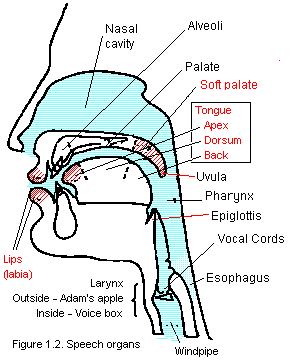
The active articulator usually moves in order to make the constriction. The passive articulator usually just sits there and gets approached.
A sounds place of articulation is usually named by using the latin adjective for the active articulator followed by the latin adjective for the passive articulator. For example:
a sond where the tongue tip approaches or touches the upper teeth is called on "apico-dental". Most of the common combinations of active and passive articulator have abbr4viated names, usually leaving out the active half.
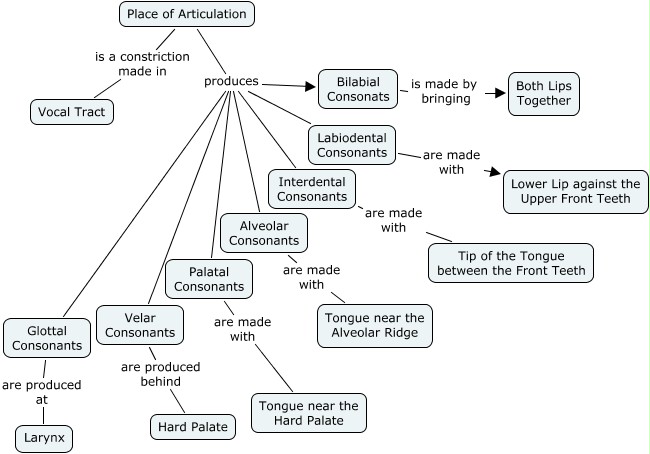
These are the abreviated names for the places of articulation used in English:
BILABIAL. ALVEOLAR, LABIO-DENTAL, DENTAL, GLOTTAL, POSTALVEOLAR, RETROFLEX, PALATAL, VELAR.
MANNER OF ARTICULATION
One parameter of manners is structure, that is how closely the speech organs approach one another.
Parameters other than structure are those involved in the r-like sounds (taps and trills), and the sibilancy of fricatives. Often nasality and laterality are included in manner, lout phoneticians such as Peter Ladefoged consider them to be independent.
These are the names for manner of articulation used in English:
PLOSIVE, NASAL, FRICATIVE, FLAP, TRILL, SIBILANTS, AFFRICATIVE, APROXIMANT, LATERAL FRICATIVE, OBSTRUENTS,SONORANTS, EJECTIVES, IMPLOSIVES, CLICKS.


HERE IS AN INTERESTING VIDEO ABOUT HOW THE VOICE IS PRODUCED. ENJOY IT!