
Since the number of consonants in all the world's languages is much greater than the number of consonant letters in most alphabets, linguists have devised systems such as the International Phonetic Alphabet (IPA) to assign a unique symbol to each possible consonant. In fact, the Latin alphabet, which is used to write English, has fewer consonant letters than English has consonant sounds, so some letters represent more than one consonant, and digraphs like "sh" and "th" are used to represent some sounds. Many speakers aren't even aware that the "th" sound in "this" is a different sound from the "th" sound in "thing."
A consonant is a sound in spoken language that is characterized by a constriction or closure at one or more points along the vocal tract. The word consonant comes from Latin meaning "sounding with" or "sounding together", the idea being that consonants don't sound on their own, but only occur with a nearby vowel; this conception of consonants, however, does not reflect a modern linguistic understanding, which defines them in terms of vocal tract constrictions.
There are a group of consonants called sonorants that sometimes act as vowels, occupying the peak of a syllable, and sometimes act as consonants. For example, in English, the sound [m] in "mud" is a consonant, but in "prism", it occupies an entire syllable, as a vowel would.
The word consonant is also used to refer to letters of an alphabet that denote a consonantsound. Consonant letters in the English alphabet are B, C, D, F, G, H, J, K, L, M, N, P, Q, R, S, T, V, W, X, Z, and sometimes Y - the letter Y stands for a consonant in "yoke" but for a vowel in "myth", for example.
Each consonant can be distinguished by several features:
- The manner of articulation is the method that the consonant is articulated, such as nasal, stop, or approximant.
- The place of articulation is where in the vocal tract the articulators of the consonantact, such as bilabial, alveolar, or velar.
- The phonation method of a consonant is whether or not the vocal cords are vibrating during articulation of a consonant. When the vocal cords are vibrating, the consonant is voiced; when they're not, it's voiceless.
- Aspiration is also a feature of phonation.
- The airstream mechanism is how the air moves through the vocal tract during articulation. Most languages have exclusively pulmonic egressive consonants, but ejectives, clicks, and implosives use different mechanisms.
- All English consonants can be classified by a combination of these, such as "voiceless alveolar stop consonant" . In this case, the airstream mechanism is omitted.
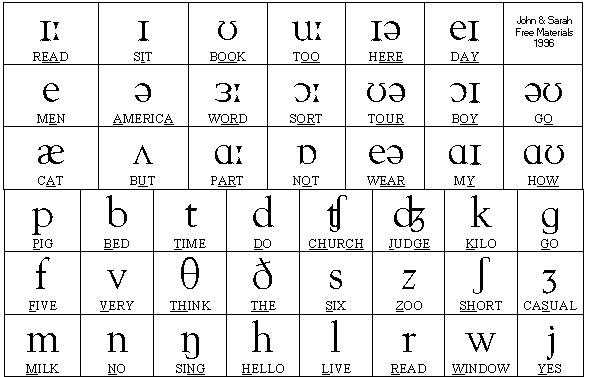

Here are some videos that help to understand the consonant sound and which is the symbol for each one.
practice at this web page: http://www.uiowa.edu/~acadtech/phonetics/english/frameset.html
|
CLASIFICATION OF CONSONANTS.ppt Size : 4812.5 Kb Type : ppt |
|
Consonants.docx Size : 20.17 Kb Type : docx |